softpaws
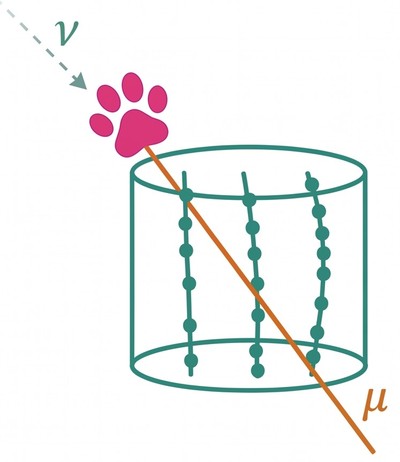
softpaws builds the response of a neutrino telescope from muon transport, without a detector simulation. It solves the transport of a high-energy muon through matter analytically, turns the resulting muon range into the volume a detector effectively watches, and from there into an effective area, an event rate, or the energy of a single track. The same code serves IceCube, KM3NeT/ARCA, P-ONE, TRIDENT and Baikal-GVD, because nothing in the construction is specific to one site.
What it is for
A published effective area comes out of a detector simulation. It answers what a detector sees, but not why, and it cannot be moved to a detector that has not been simulated. softpaws computes the same quantity from the loss spectrum of the medium, the neutrino cross section, the geometry of the instrumented volume, and two numbers per site that the instrument itself sets: a selection threshold and a light reach.
That makes three things possible. You can reproduce a published effective area and see which ingredient carries each feature. You can predict the response of a detector that has no published table yet. And you can ask what a measurement would look like under a different loss model, which is how the error on the transport itself is measured.
What is inside
| Subpackage | What it holds |
|---|---|
softpaws.transport |
The loss spectrum, the transport exponent, the muon range, the loss law, Earth geometry and attenuation, and the tau channel |
softpaws.detectors |
Published geometry, medium and optics for each site |
softpaws.fluxes |
Power laws, the published IceCube fits, and the atmospheric background |
softpaws.response |
Effective areas: from the light reach, from the published optics, and resolved by declination |
softpaws.comparison |
Likelihoods, posterior statistics, the event benchmark, and single-track energy reconstruction |
softpaws.data |
Loaders for the IceCube release and for the published curves of the other detectors |
Where to start
Read Installation, then Quickstart for five calls that take you from a detector to an effective area to an event rate, and Your own detector for a layout or a flux of your own. Data explains what ships with the package and what you have to download. The API reference is generated from the docstrings.
The method is described in Estimating High-Energy Neutrino Effective Areas from Muon Propagation, arXiv:2609.40188. See Citation.