CP violation with atmospheric neutrinos
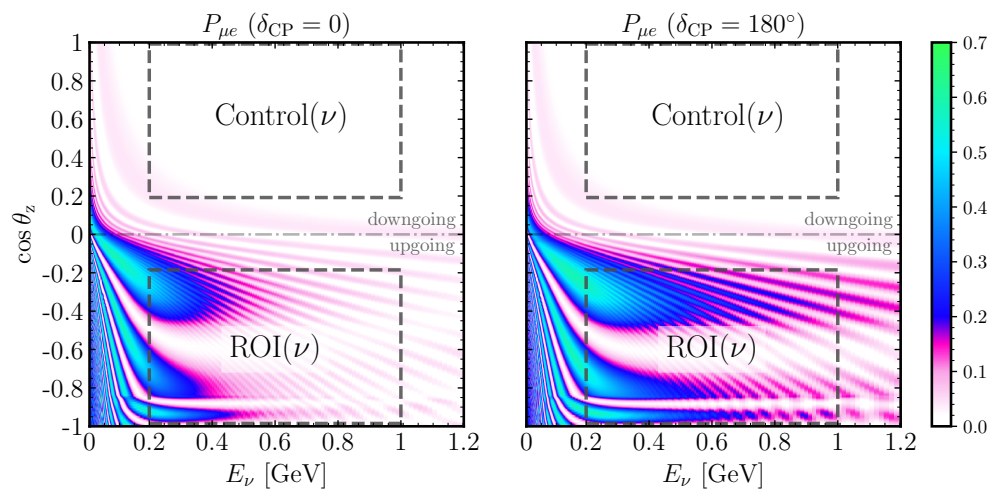
Sub-GeV atmospheric neutrinos give Hyper-K and DUNE a measurement of the CP-violating phase that is independent of accelerator systematics.
Preprint, 2026 · arXiv:2605.16721
Postdoctoral Research Fellow in Neutrino Phenomenology
University of Iowa, Department of Physics and Astronomy
I find the measurements next-generation neutrino detectors weren't designed for, and show they can make them. These range from leptonic CP violation with atmospheric neutrinos to new probes of dark matter. Having worked inside IceCube, P-ONE and Borexino, I build the transport and simulation tools that make these predictions hold up at the detector level.

Sub-GeV atmospheric neutrinos give Hyper-K and DUNE a measurement of the CP-violating phase that is independent of accelerator systematics.
Preprint, 2026 · arXiv:2605.16721
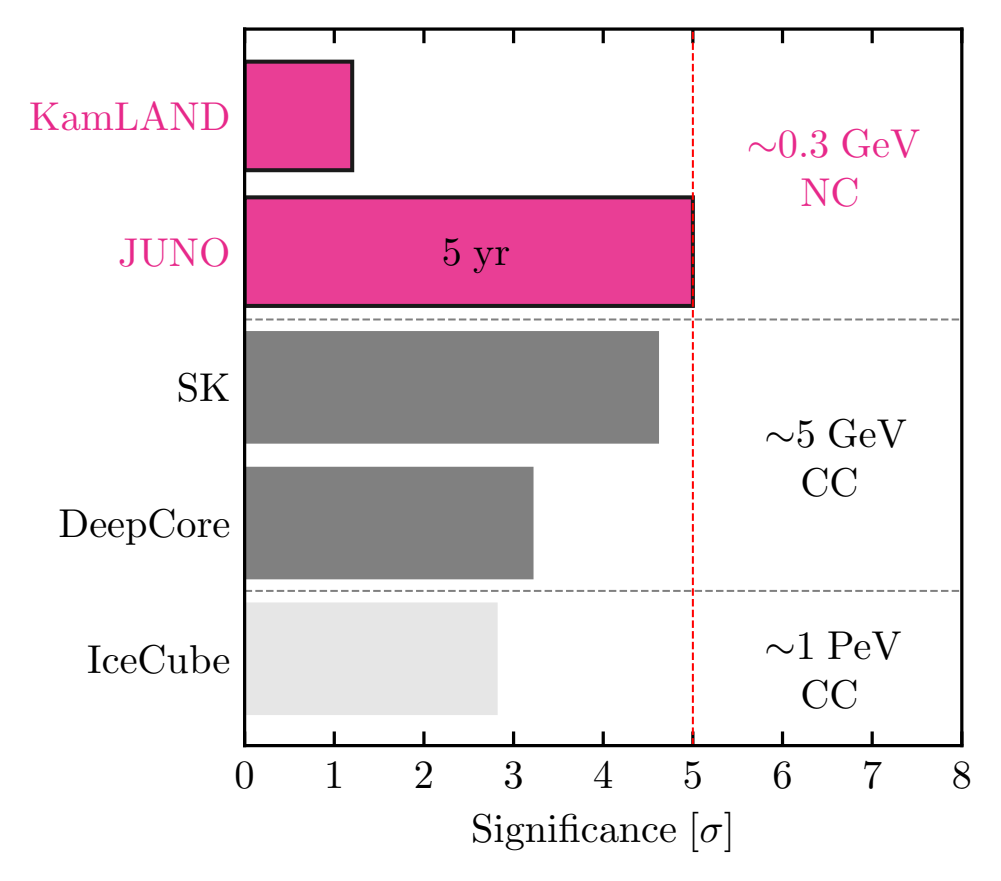
A new neutral-current signature lets JUNO observe atmospheric $\nu_\tau$ appearance at 5$\sigma$, at energies no other experiment reaches.
Phys. Rev. D, 2024 · arXiv:2311.01667
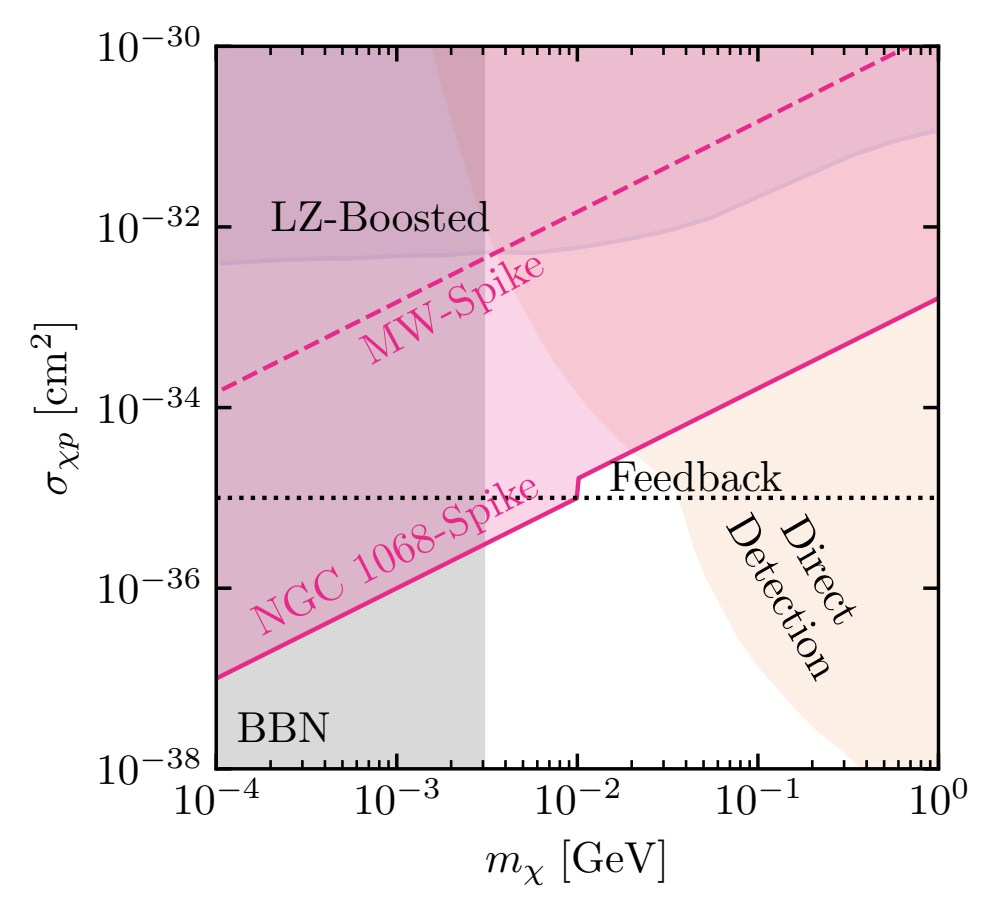
The existence of ultrahigh-energy cosmic rays constrains dark matter-proton scattering, probing sub-GeV masses that direct detection cannot reach.
Phys. Rev. D, 2026 · arXiv:2512.18093
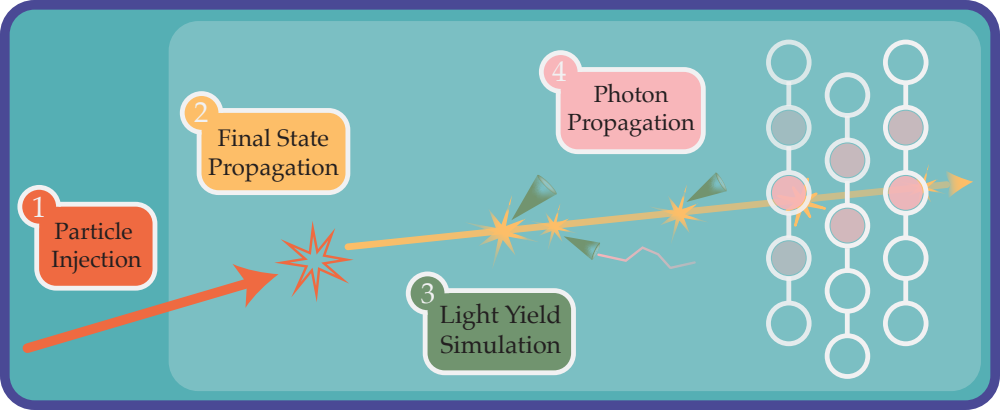
The first public end-to-end simulation for neutrino telescopes in ice and water, now a community baseline.
Comput. Phys. Commun., 2024 · arXiv:2304.14526
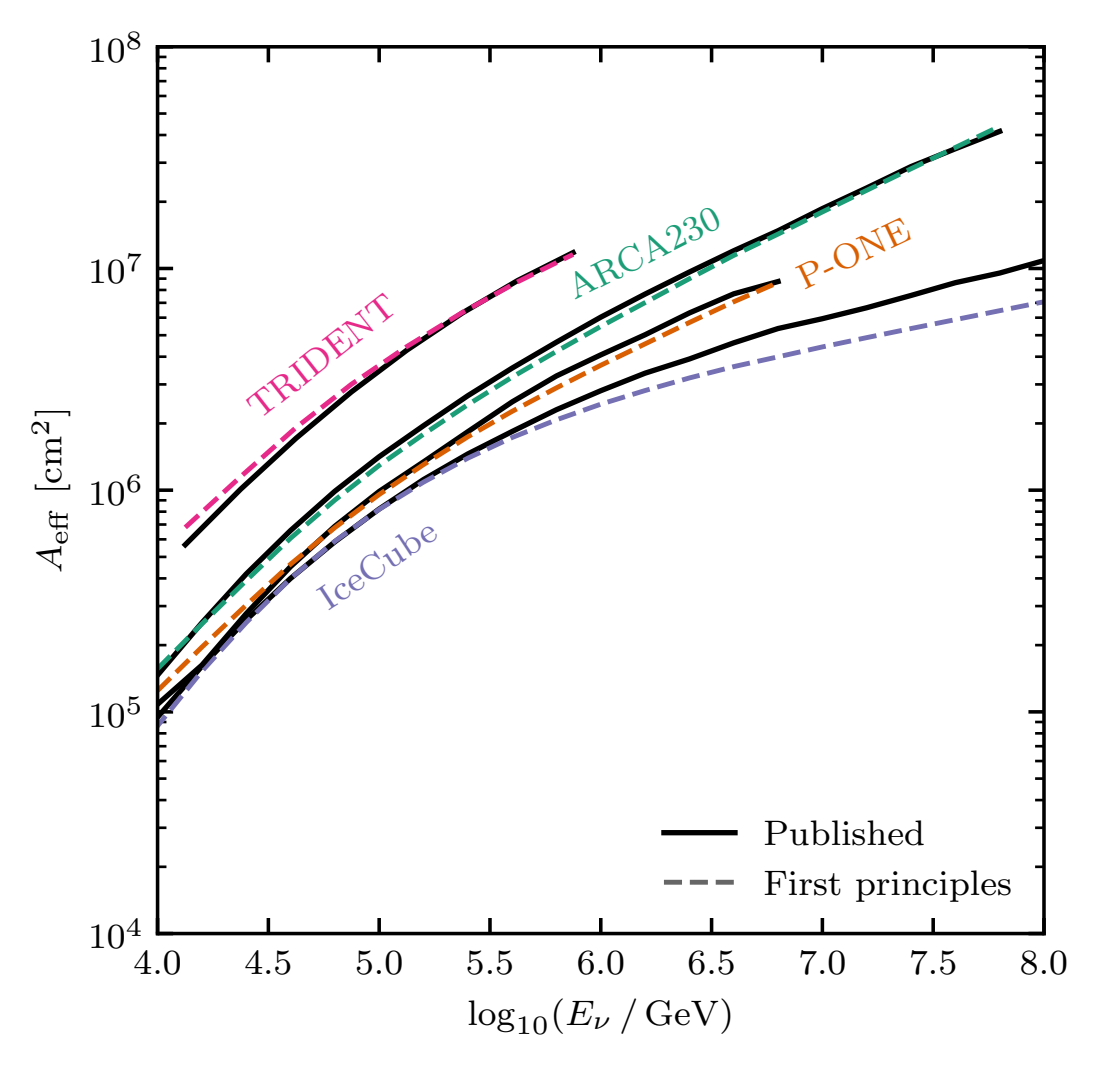
Neutrino telescopes see neutrinos through muons born kilometers outside the detector, and how far those muons travel sets how many neutrinos a telescope can catch. I compute that range analytically, including the random way muons lose energy. With two numbers per detector, the result matches the published effective areas of IceCube, KM3NeT/ARCA and P-ONE to about 1%. The calculation is available as the open Python package softpaws 1.0.
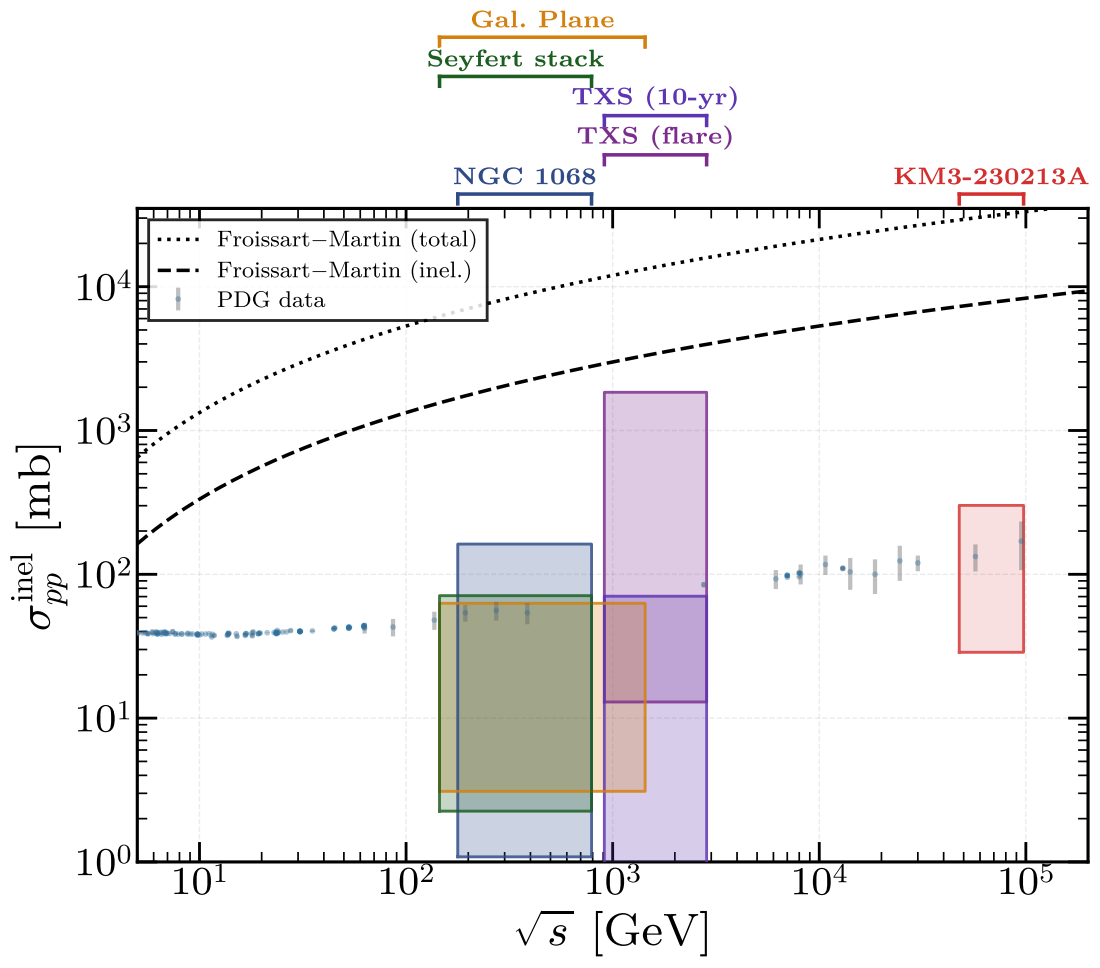
Cosmic accelerators reach collision energies far beyond any machine on Earth, and the neutrinos they emit carry information about those collisions. With Carlos Argüelles and colleagues, we fix every astrophysical ingredient of a source from light observations, so that the proton collision cross section is the only unknown left. Applied to IceCube's neutrino sources and the record-energy KM3NeT event, this bounds collisions at energies up to about $10^5$ GeV, some well beyond the LHC. My part was computing how $pp$ and $p\gamma$ collisions produce neutrinos.
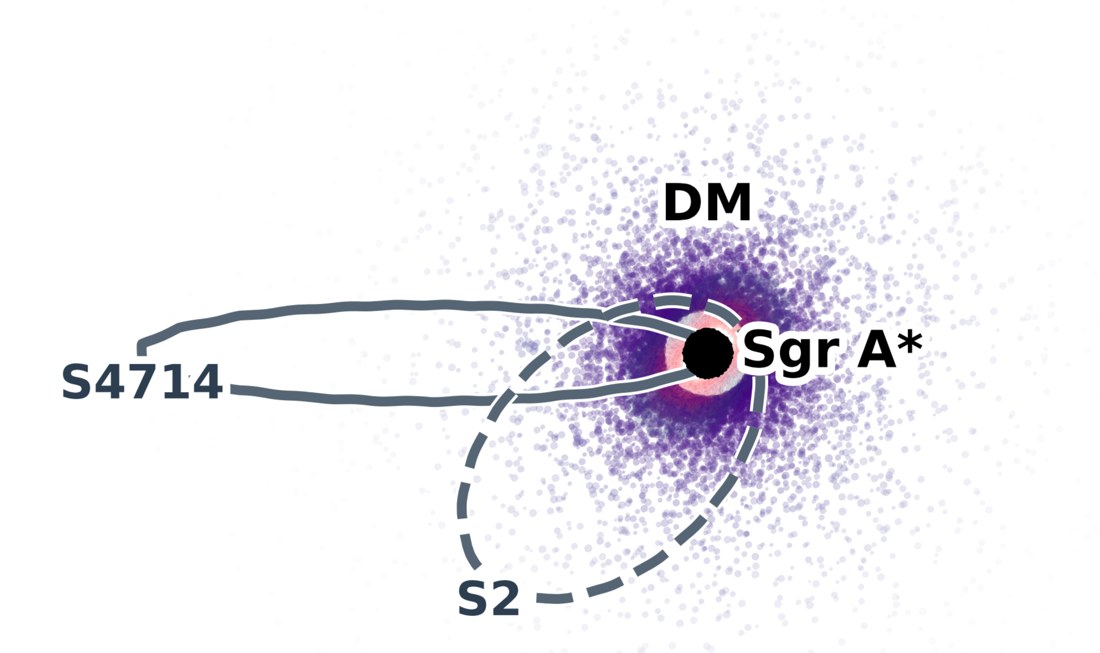
A few stars orbit the black hole at the center of our Galaxy on very tight paths, and if dark matter piles up there, they plunge through it on every orbit. With colleagues, we compute how much energy dark matter would exchange with such a star, using S4714 as an example. For a dense dark matter spike, this energy can match the star's own luminosity for interaction strengths that popular production scenarios predict. That makes the Galactic Center a natural laboratory for dark matter, complementary to detectors on Earth.