Software

Open simulation tools are a core research output. They exist to make the phenomenology testable, and they are used by the neutrino-telescope community to model detectors that do not yet exist and the environments they will be built in. Listed here are the codes built for general use. Analysis code for individual papers lives on GitHub.

softpaws

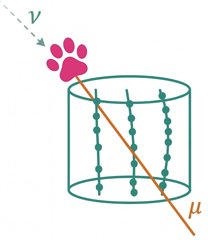
Neutrino-telescope effective areas from muon transport, without a detector simulation.

Solves high-energy muon transport analytically and turns the muon range into the volume a detector effectively watches, giving effective areas, event rates and single-track energies. One code serves IceCube, KM3NeT/ARCA, P-ONE, TRIDENT and Baikal-GVD, so published effective areas can be reproduced, explained and carried to detectors that have not been simulated yet. Author and maintainer.


Docs GitHub PyPIPaper

v1.0.0 (2026-09)updated 2026-10

Prometheus

Open-source, end-to-end simulation framework for neutrino telescopes.

Generates events and detection-module photon hits for user-defined detector geometries in water or ice. Lead developer and current maintainer. Released publicly (Comput. Phys. Commun. 2024) and adopted as a community baseline, including for the NuBench event-reconstruction benchmark.

Docs GitHub Paper

updated 2026-09

Fennel

Fast parametric Cherenkov light yields for tracks and cascades.

Predicts photon counts and timing distributions from muon tracks, electromagnetic showers, and hadronic showers in ice or water. Author and maintainer. Provides the light-yield backend used in Prometheus.

Docs GitHub PyPI

v1.3.4 (2022-07)updated 2026-09

bib-checker

Check a BibTeX file against INSPIRE and fix what is wrong.

Command-line tool that checks every entry of a .bib file against InspireHEP, flags missing or mismatched records, suggests canonical replacements and writes a corrected file. Author and maintainer.

Docs GitHub

updated 2026-06

Community contributions

Open tools for training students and running a research group.

nestling

A physics-first starting kit for early-career researchers.

Short guides, templates, examples and exercises in seven tracks. They cover reading arXiv papers, journal clubs, writing papers, Git and GitHub, coding practices, plotting, and working with LLMs. Used to onboard new students. Author and maintainer.

Docs GitHub

updated 2026-06

jc-ppi

Iowa Particles & Plots Journal Club.

Website and workflow for the journal club. Members suggest papers as GitHub issues, a bot fills in the details from INSPIRE, and the site groups them by week. Runs entirely on GitHub Actions, with nothing to host. Author and maintainer.

Website GitHub

updated 2026-09

Earlier tools